
The Resource Forecast feature allows you to simulate available capacity by configuring various types of work shifts.
You can create forecasts based on either:
-
Actual resources and calendars already defined in the system.
-
Simulated resources and calendars for hypothetical scenarios.
A significant advantage of using resource forecasts is their complete independence from actual resource and calendar data. This means any adjustments or edits made within the forecast simulation will not impact the live operational data in your system.
Before you start
-
Create the resource forecast
Configure a Resource Forecast
-
In the FSM App, navigate to FEATURES → FORECASTING & CAPACITY PLANNING → RESOURCE FORECAST
-
Use the filter panel to search for existing forecast records
-
Clicking the option button related to the Resource Forecast, going on “Detail” option the configuration page will be showed as a calendar view.
The calendar view allows to define all resource’s work-shift.
The configuration panel allows to customize the calendar view’s visualization, defining:
-
Mode: work-shift’s granularity (day, week, month). It defines if visualize all work-shifts day by day or collapsed by week or month.
-
Columns: number of days to display in the calendar view.
-
Start Date: start date to visualize on the calendar view (included in the resource forecast period)
-
Resource: select resources to visualize on the calendar view.
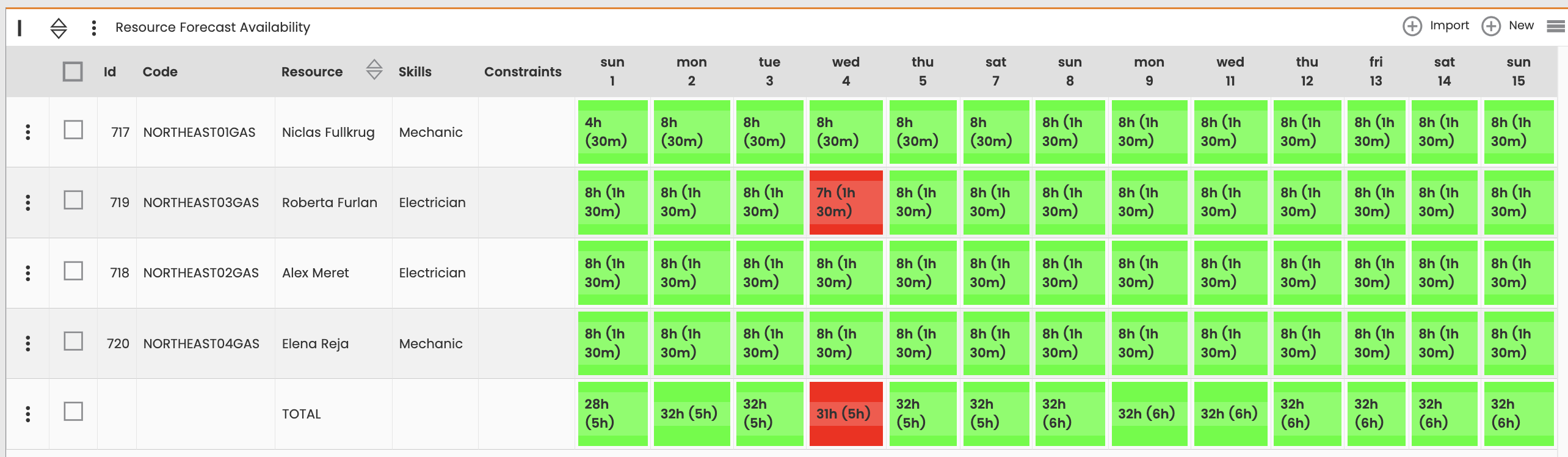
Selecting the “Day” mode in the configuration panel, the work-shift is detailed day by day.
|
|
Figure 1 - Resource forecast calendar view |
For each day a colored cell defines the work-shift in this way:
-
Work duration hours (overtime hours)
The cell’s color defines the availability:
-
green: it means there isn’t unavailability
-
red: it means there is unavailability
The TOTAL row sums up all resource’s hours defined in the forecast.
Hovering a cell, a tooltip will show more information about the work-shift.
-
Work Duration: ordinary time of the work-shift
-
Unavailability: unavailability time in the work-shift
-
Unusable time: free time of the resource
-
Max overtime: overtime defined in the work-shift
Example:
-
4h (30m): it means that the resource works 4 hours of ordinary time and 30 minutes of overtime. No unavailability
-
4h (30m): it means that the resource works 4 hours of ordinary time and 30 minutes of overtime. There is an unavailability.